 admin
adminLegacy Trust vs Charitable Trust: Key Differences for Your Estate Plan
You've worked hard to build your assets and want to ensure they are managed and distributed according to your wishes, both for your loved ones and the causes you care about. However, the world of estate planning can be confusing, filled with complex legal terms like "trusts." Two powerful tools often mentioned are the Legacy Trust and the Charitable Trust. While both are trusts designed to manage and distribute assets, they serve fundamentally different purposes. Choosing the wrong one could mean your wealth doesn't go where you intend, potentially leading to family conflict or missed philanthropic opportunities. Understanding the key differences between a legacy trust and a charitable trust is crucial for creating an effective, purposeful estate plan.
This guide will break down the distinct objectives, structures, tax implications, and ideal use cases for each, empowering you to make an informed decision aligned with your personal and financial goals.

Understanding the Core Purpose: Family vs. Philanthropy
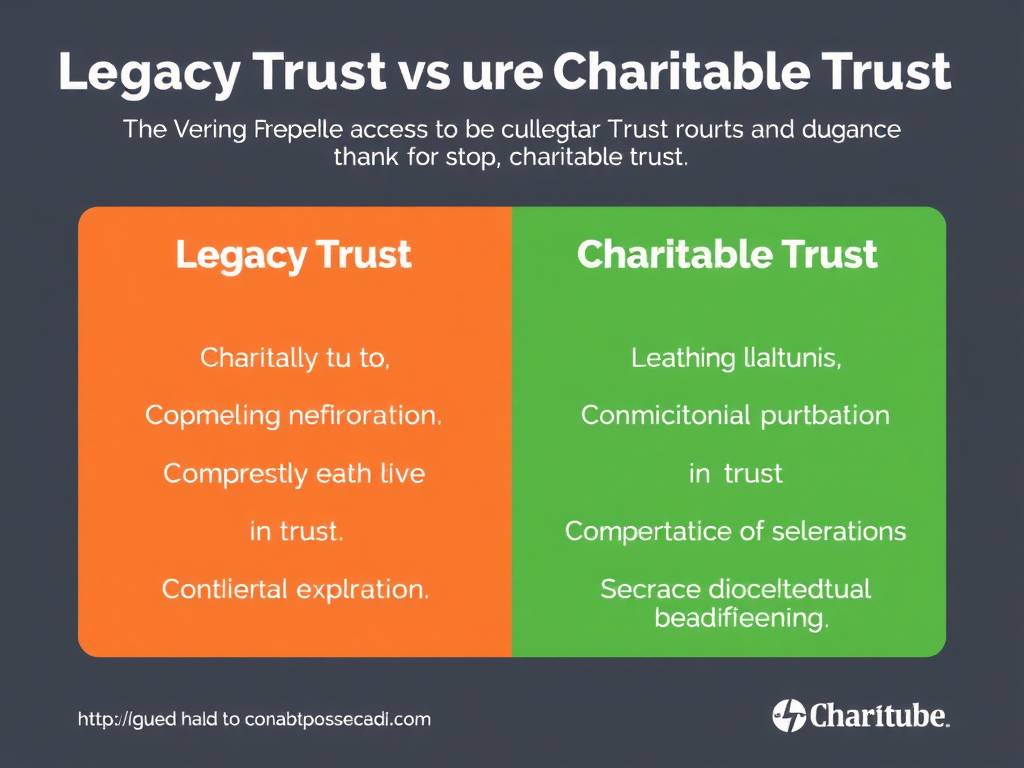
The most significant difference lies in their primary intent. ALegacy Trust, often synonymous with a Dynasty Trust or a Family Trust, is fundamentally designed to preserve and transfer wealth to your descendants or other named beneficiaries (like family members) for multiple generations. Its core mission is family legacy, providing financial security, education, and opportunity for your heirs while often protecting assets from creditors, divorce, or excessive estate taxes over time.
In contrast, aCharitable Trustis a philanthropic vehicle. Its primary purpose is to benefit one or more qualified public charities. While it can also provide income to non-charitable beneficiaries (like yourself or family members), the ultimate remainder of the trust's assets must go to charity. The driving force here is to support a cause, create a lasting charitable legacy, and achieve specific tax advantages tied to charitable giving.
Structural and Operational Differences
How these trusts are set up and function day-to-day varies significantly.
How a Legacy Trust WorksA Legacy Trust is typically an irrevocable trust, meaning once it's funded, the terms generally cannot be changed. You, as the grantor, appoint a trustee (which can be a person, a bank, or a trust company) to manage the assets for the benefit of your chosen beneficiaries. The trust document provides detailed instructions on when and how distributions are made—for example, for health, education, maintenance, and support (HEMS standards), or at specific ages. Its duration is often governed by state "Rule Against Perpetuities" laws, but many states allow these trusts to last for several generations, even hundreds of years.
How a Charitable Trust WorksCharitable trusts come in two main types, each with a distinct structure:
- Charitable Remainder Trust (CRT):You transfer assets (like appreciated stock or real estate) into the CRT. The trust then sells the assets tax-free. For a set term or for your lifetime, the CRT pays an income stream to you or other non-charitable beneficiaries. At the end of the term, the "remainder" goes to your designated charity. This structure is ideal if you want current income and a future charitable gift.
- Charitable Lead Trust (CLT):This operates in the reverse order. The trust pays an income stream to one or more charities for a set period. After that term ends, the remaining assets are distributed to your non-charitable beneficiaries, such as your children. This is useful if you want to support a charity now and pass assets to family later, potentially with reduced transfer taxes.
Tax Implications: A Major Divergence
Tax treatment is where the differences become starkly technical and financially impactful.
Legacy Trust Tax ConsiderationsThe primary tax goal of a Legacy Trust is oftenwealth transfer tax mitigation. When properly structured as an irrevocable trust, the assets placed inside, plus future appreciation, are removed from your taxable estate. This can shield them from federal and state estate taxes upon your death. However, these trusts are often subject to their own compressed income tax brackets, and complex rules like the Generation-Skipping Transfer Tax (GSTT) may apply. The benefit is long-term preservation, not an immediate income tax deduction.
Charitable Trust Tax AdvantagesCharitable trusts offer immediate and ongoing tax benefits tied to the charitable component. With aCharitable Remainder Trust, you receive an upfront income tax deduction for the estimated present value of the remainder interest that will eventually go to charity. The trust's sale of appreciated assets does not trigger capital gains tax, allowing for more tax-efficient reinvestment. For aCharitable Lead Trust, you may receive a deduction for the value of the income stream going to charity, and assets passing to heirs at the end of the term may do so with little or no gift or estate tax.
Which Trust Is Right for You? Key Decision Factors
Choosing between these tools depends on your hierarchy of goals.
When a Legacy Trust is the Preferred Choice
- Your paramount goal is to provide for and protect your children, grandchildren, and beyond.
- You have significant assets that may be subject to estate taxes.
- You are concerned about beneficiaries' potential creditors, divorcing spouses, or financial immaturity.
- You wish to keep wealth within the family bloodline for generations.
When a Charitable Trust is the Preferred Choice
- You have a strong philanthropic desire and want to make a substantial gift to charity.
- You hold highly appreciated assets (like stock or real estate) and seek to avoid capital gains tax on their sale.
- You want to supplement your retirement income (CRT) or provide for family after a charitable term (CLT).
- Your goal is to maximize current-year income tax deductions while fulfilling charitable intentions.
Can You Combine These Strategies?
Absolutely. A comprehensive estate plan is not an either-or proposition. Many individuals use both tools in tandem. For example, you could:
- Fund a Charitable Remainder Trust with appreciated stock to receive lifetime income and a tax deduction.
- Use the increased income from the CRT to fund annual gifts to a Legacy Trust for your grandchildren.
- Upon your passing, the CRT remainder benefits your favorite charity, while the Legacy Trust assets pass to your heirs protected from estate tax.
This layered approach allows you to address multiple objectives: philanthropy, income, and multi-generational legacy planning.
Addressing Common Questions
Can my family be involved in a Charitable Trust?Yes, but with a key distinction. In a Charitable Remainder Trust, you or your family members can be the non-charitable income beneficiaries for a term or for life. In a Charitable Lead Trust, your family receives the assets after the charitable term ends. However, the trust must irrevocably designate that a qualified charity will ultimately receive a benefit, which is the core of its tax-advantaged status.
Is a Legacy Trust only for the extremely wealthy?Not necessarily. While often used for high-net-worth estate tax planning, the asset protection and structured distribution benefits of a Legacy Trust are valuable for anyone who wants to ensure managed, responsible access to wealth for their heirs, regardless of the total size of the estate. It's about control and protection, not just tax avoidance.
Which trust offers more control over the assets?As the grantor, you relinquish direct control when funding an irrevocable trust, whether Legacy or Charitable. Your control is exercised upfront by meticulously drafting the trust agreement. In a Legacy Trust, you dictate terms to the trustee for your beneficiaries. In a Charitable Trust, you define the charitable beneficiaries, income terms, and trustees. The trustee, however, has the fiduciary duty to manage the assets according to those irrevocable terms. For ongoing control, a revocable living trust is different, but it does not offer the same tax or asset protection benefits as these irrevocable structures.
Both Legacy Trusts and Charitable Trusts are sophisticated instruments that can profoundly shape your financial legacy. The decision hinges on a clear understanding of your foremost intent: is it to perpetuate family wealth and values across generations, or to anchor your legacy in philanthropic achievement with associated tax benefits? Often, the most resonant plan incorporates elements of both. Consulting with an experienced estate planning attorney and a financial advisor is essential to navigate the legal and tax complexities, ensuring the structure you choose faithfully executes your vision for the future. By aligning your tools with your true priorities, you create not just a plan for your assets, but a meaningful legacy that reflects your life's work and values.




发表评论